Why a Modern Website Is Now Essential for Equipment Rental Companies
June 3, 2026
.webp)
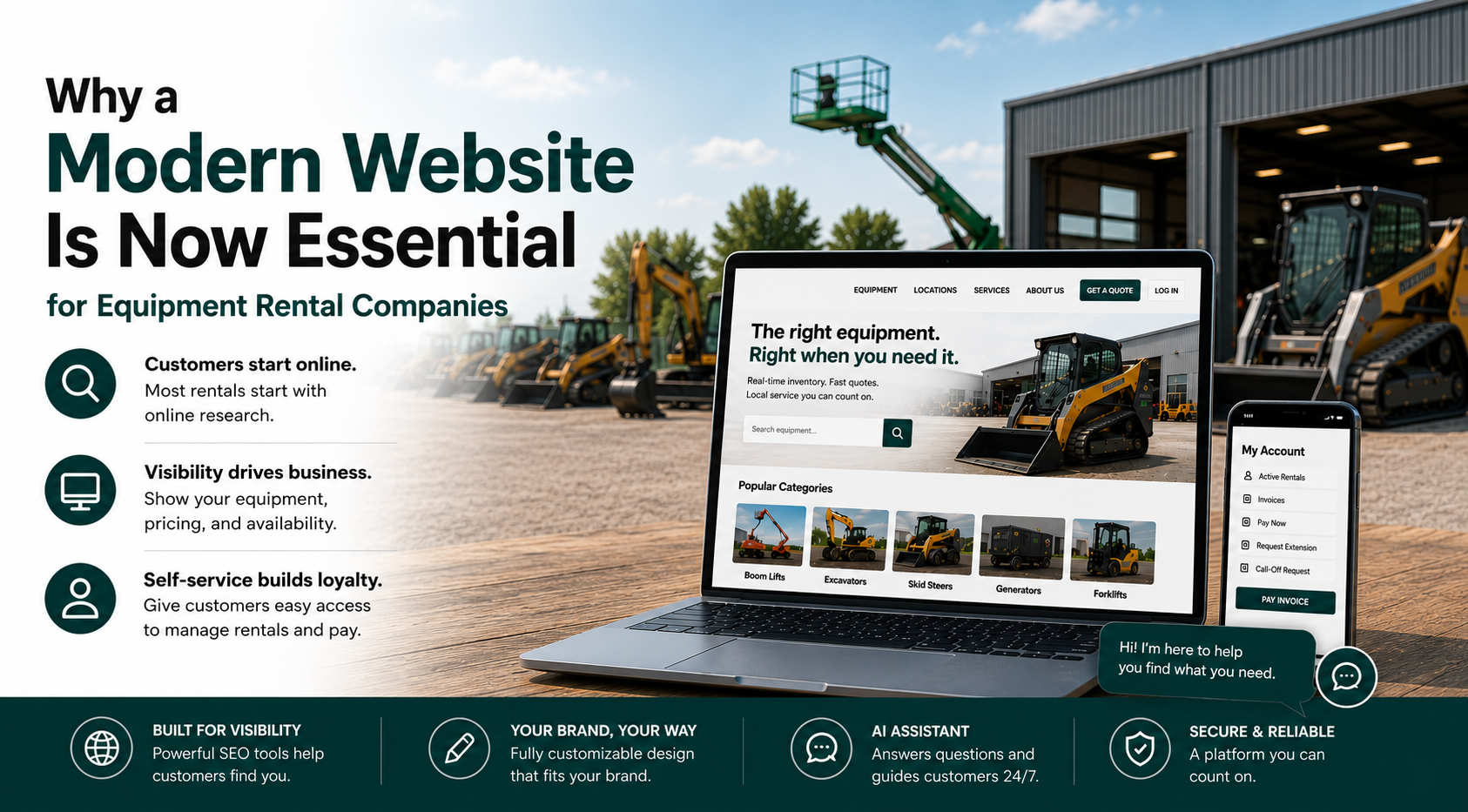
The equipment rental industry has always been built on relationships.
Great service, knowledgeable employees, responsive communication, and strong local reputations remain some of the most important factors that drive customer loyalty. Contractors still value working with people they know and trust. They still call rental counters for advice. They still rely on experienced rental professionals to help solve problems and keep projects moving.
What has changed is how those relationships often begin.
Today, the vast majority of rental customers start their buying journey online. Before contacting your branch for the first time, requesting a quote, or stepping foot inside your store, they're researching equipment, comparing providers, reading reviews, and evaluating their options.
For rental companies, this means your website is no longer simply a marketing asset. It has become one of the most important touchpoints in the customer journey and, increasingly, one of the most important drivers of revenue growth.
A modern rental website is no longer just a digital brochure. It has become a sales channel, a customer service platform, a marketing engine, and an extension of your rental counter itself.
The Modern Rental Customer Starts Online
Whether someone needs a skid steer, boom lift, generator, mini excavator, or forklift, their process typically begins long before they ever contact a rental company.
Most customers start with a Google or Google Maps search. They compare local providers, browse available equipment, review specifications, evaluate pricing, and read customer reviews. By the time many customers reach out to a rental company, they've already narrowed their list of potential providers and formed opinions about which businesses appear most capable of meeting their needs.
Industry studies consistently suggest that 70%+ of rental transactions begin with some form of online research. While the final transaction may still involve a phone call, a branch visit, or a conversation with a salesperson, the buying decision is increasingly influenced by the online experience that comes beforehand.
This shift has fundamentally changed the role of a rental company's website.
In many cases, your website creates a customer's first impression of your business long before they ever speak with someone on your team. An outdated website, limited equipment information, poor mobile experience, or lack of self-service capabilities can create friction before a conversation ever occurs.
Conversely, a professional and modern online experience builds trust and credibility before the first phone call.
Customer Expectations Continue to Rise
Today's renters expect much more than a simple equipment catalog.
Customers increasingly want immediate answers to questions like:
- Do you have the equipment I need?
- Is it available?
- What does it cost?
- What are the specifications?
- Can I request a quote online?
- Can I reserve equipment digitally?
- Can I manage my account without calling?
These expectations aren't unique to equipment rental. They are shaped by virtually every other online experience customers have throughout their day.
People can book flights, order products, schedule services, manage bank accounts, and pay bills online. Naturally, they increasingly expect the same level of convenience when renting equipment.
When information is difficult to find or processes require unnecessary phone calls and back-and-forth communication, many customers simply move on to another provider.
And for companies that provide a seamless experience, they create customers for life. The companies that make it easiest to do business with them often win.
Visibility Matters More Than Ever
One of the biggest challenges facing independent rental companies today is simply making inventory visible online.
Many rental businesses still have websites that provide limited information about the equipment they offer. Customers may see a basic product listing (which is often outdated!) but have no visibility into specifications, pricing, availability, or related rental information. This creates friction in the buying process.
The more information customers can access on their own, the easier it becomes for them to move forward with confidence.
Visibility is also closely tied to search engine optimization (SEO). A great website is only valuable if customers can actually find it. Search engines remain the primary way most customers discover rental providers, making SEO one of the most important aspects of a modern website strategy. Rich equipment descriptions, detailed specifications, optimized page content, location-specific pages, and customizable metadata all play an important role in helping rental companies rank higher in search results.
In many cases, the rental company that appears first in search results earns the opportunity before competitors even get a chance to participate.
As competition for online visibility continues to increase, strong SEO capabilities are becoming just as important as having inventory available online.
Customer Portals Are Becoming a Competitive Necessity
The expectations don't stop after the rental begins. Increasingly, customers want self-service access to their rental accounts.
Think about how people interact with banks, airlines, utility providers, and virtually every other service they use. Customers have become accustomed to logging in and accessing information whenever they want rather than waiting for business hours or calling customer support. Equipment rental is heading in the same direction, with every large national company now supporting online Customer Portals.
Many renters now expect the ability to:
- View active rentals
- Review invoice history
- Pay open invoices online
- Submit call-off requests
- Request rental extensions
- Access account information
- Review past rental activity
For rental companies, customer portals create benefits that extend far beyond convenience.
Reducing inbound phone calls, speeding up collections, minimizing administrative work, and improving customer satisfaction can have a meaningful impact on operational efficiency. What was once viewed as a premium feature is quickly becoming an expected part of the rental experience.
Artificial Intelligence Is Changing the Online Rental Experience
Another major shift occurring across the industry is the growing role of artificial intelligence. Customers have become increasingly comfortable interacting with AI-powered tools when shopping online. Rather than manually searching through pages of inventory or navigating complex websites, they increasingly expect technology to help guide them toward the right solution.
The rental industry is beginning to embrace this trend as well. United Rentals recently introduced an AI-powered website assistant designed to help customers find equipment and navigate their online experience more effectively. This is likely only the beginning.
Imagine a customer visiting your website and asking:
"I need a lift that can reach 40 feet."
Or:
"What's the best machine for moving pallets around a warehouse?"
Instead of forcing the customer to browse dozens of equipment listings, an AI assistant can identify relevant equipment, explain specifications, answer common rental questions, and guide the customer toward requesting a quote. The goal isn't to replace your rental experts. The goal is to provide customers with faster access to information while helping them move more efficiently from browsing to renting.
In many ways, AI is becoming a digital extension of the rental counter.
Online Revenue Is Becoming a Meaningful Growth Driver
For many rental companies, websites have traditionally been viewed as marketing tools. Increasingly, they are becoming direct revenue-generating channels.
Across Renterra's customer base, many rental businesses now generate more than 25% of their rental activity directly through their online storefronts. Many have generated well over $100,000 in online rental revenue through digital channels.
Customers are discovering equipment, requesting quotes, browsing inventory, and initiating transactions online at all hours of the day. This doesn't replace relationships or sales teams. Instead, it creates a more efficient buying experience that helps rental companies capture opportunities they may have otherwise missed.
For businesses looking to grow revenue without proportionally increasing administrative workload, online requests represent a significant opportunity.
What Defines a Modern Rental Website?
A modern website is much more than an online equipment catalog.
The best rental websites combine discoverability, functionality, branding, and customer convenience into a single experience.
Key characteristics of a modern rental website include:
- Real-time inventory visibility
- Mobile-friendly design
- Rich equipment descriptions and specifications
- Strong SEO capabilities
- Self-service quoting and booking
- Customer portal functionality
- AI-powered customer assistance
- Brand customization and design flexibility
Most importantly, the website should feel like a natural extension of your business rather than a generic template.
Customers should immediately recognize your brand, understand your value proposition, and feel confident doing business with you.
Introducing Renterra's Next Generation Storefront
Recognizing how rapidly customer expectations are evolving, Renterra has just launched the second generation of its Integrated Storefront platform.
This represents a significant evolution from the original storefronts introduced several years ago and reflects the growing importance of digital experiences within the rental industry.
The goal was simple: help independent rental companies launch modern, enterprise-grade online experiences without requiring developers, designers, or lengthy implementation projects.
Live Site in Minutes
Renterra's AI can automatically generate an entire storefront using inventory that already exists within your rental software.
Equipment descriptions, specifications, images, and branded pages are generated automatically, allowing rental companies to launch professional websites in a fraction of the time traditionally required.
Real-Time Inventory
Storefronts connect directly to your Renterra account to display live inventory, pricing, and availability.
Customers can browse with confidence knowing the information they are seeing reflects your actual fleet.
Self-Service Quoting & Booking
Customers can request quotes and initiate bookings on their own schedule, creating a more convenient buying experience while reducing friction in the sales process.
Built-In Customer Portal
Existing renters can securely access their account to pay invoices, view active rentals, submit call-off requests, request extensions, and review account history.
This creates a better customer experience while reducing administrative workload for your team.
AI Storefront Assistant
An embedded AI storefront assistant acts as a digital rental expert available 24/7.
Customers can ask questions about equipment, receive guidance on which machine may be best suited for a project, learn about specifications, understand rental policies, and quickly locate inventory that matches their needs.
The result is a faster path from browsing to booking while reducing repetitive questions directed to your staff.
Powerful SEO Controls
Renterra's next-generation storefronts are designed with search visibility in mind. Rental companies can customize page content, metadata, imagery, and other SEO-focused elements to help improve discoverability and drive more organic traffic.
Full Design Customization
Every rental company has a unique identity. Storefronts can be fully -customized with unique colors, themes, imagery, layouts, and page styling so the website feels like a natural extension of your brand rather than a generic rental website template.
This allows independent rental companies to maintain the personality and local identity that often differentiates them from larger national competitors.
The Bottom Line
The fundamentals of the rental industry haven't changed. Relationships still matter. Service still matters. Trust still matters.
What has changed is how customers discover, evaluate, and engage with rental companies. A modern website is no longer a luxury reserved for national rental chains. It has become a critical component of competing in today's market. Customers expect visibility into inventory. They expect self-service capabilities. They expect modern design. They expect strong online search experiences. Increasingly, they expect intelligent tools that help them find what they need faster.
The good news is that independent rental companies no longer need massive budgets or dedicated development teams to deliver these experiences. With the right technology, businesses of any size can provide the modern online experience today's renters expect while continuing to deliver the exceptional service and relationships that have always defined the rental industry.
Let’s make rentals easier
See how Renterra helps you work faster, get paid quicker, and keep your team on the same page.