Renterra's Blog & Insights
Your premier source for insights, trends, and strategies revolutionizing the rental industry landscape.

How Digital Contracts and eSignatures Speed Up Equipment Rental Checkout
It's 7:00 am on a Monday morning. There are four contractors at the counter, two trailers waiting in the lot, and the printer just jammed. Every one of those customers is ready to go. The equipment is staged. But you can’t print the rental contracts.
For most rental businesses, the paperwork at pickup is the slowest part of the whole transaction. Printing the agreement, walking through the terms, collecting initials, getting a signature, scanning a copy, and filing the original all happen while the customer waits. Digital contracts and eSignatures move most of that work out of the checkout line. The customer signs before they arrive, or signs in seconds on a phone or tablet at the counter, and the signed copy is saved to the order automatically.
This guide covers where paper contracts cost you time and protection, how eSignatures change the checkout process, and what to look for in a digital contract setup that actually fits how rental operators work.
Where Paper Contracts Slow Down Checkout
Paper contracts don't just take time to sign. They create work before, during, and after every rental.
Before pickup. Someone has to pull the right template, fill in the customer, equipment, and dates, and print it. If the order changes (a different unit, an extra day, an added attachment), the contract gets reprinted.
At the counter. The customer reads, initials, and signs while the line behind them grows. If the person picking up isn't the person authorized to sign, the whole thing stalls while someone calls the office.
After the rental goes out. The signed copy has to be scanned, filed, or matched to the order. If it gets misplaced, there's no signed agreement on record for that rental.
When the customer never comes to the counter. Deliveries are where paper contracts break down completely. The customer calls in the order, the equipment gets loaded, and the truck heads straight to the jobsite. There's no counter visit and no natural moment to sign. The driver might bring a paper copy, but the person on site often isn't the one authorized to sign it, and on a busy day nobody asks. For many rental companies without eSignatures, delivery rentals simply go out unsigned. That equipment can sit on a jobsite for weeks with no signed agreement behind it.
On a busy morning, keeping up depends on luck and on nobody skipping a step. Staying protected is a bet that the right person remembered to get every signature and file every copy. It works until the day it doesn't, and that day is usually the one where you need the contract most.
The Real Cost: Time at the Counter and Gaps in Protection
The time cost is the easiest to see. Every minute spent on paperwork is a minute your counter staff isn't helping the next customer, loading a trailer, or answering the phone. During peak season, that adds up to longer lines, rushed conversations, and customers who remember the wait more than the service.
The protection cost is harder to see until something goes wrong. A rental agreement is what holds up when there's a damage claim, a late return, or a dispute over terms. A contract that was never signed, is missing initials on the damage waiver, or is sitting in the wrong folder doesn't do much for you in that moment. The risk is highest on deliveries, where there may be no signed contract at all.
Both problems have the same root cause: a process that only works if every person completes every step by hand, every time.
How Digital Contracts and eSignatures Change the Process
With digital contracts, the agreement is generated from the order itself, so the customer, equipment, dates, and pricing are already filled in. From there, the contract can be signed a few different ways depending on the rental.
Send the contract before pickup
The simplest way to speed up checkout is to get the signature before the customer arrives. With Renterra's contract eSignatures, you can send the rental agreement by text or email straight from the order screen. The customer opens it on their phone, tablet, or computer and signs with no login, app, or account required. When they show up, the paperwork is already done.
This matters most for deliveries. Instead of hoping someone on the jobsite signs a paper copy, you get a signed contract before you load the truck. It also makes a simple rule possible: the equipment doesn't leave the yard until the contract is signed.
Sign in person when you need to
Not every customer signs ahead of time. Walk-ins, last-minute changes, and first-time renters still happen. Signatures can also be collected in person at the counter or in the yard on the mobile app, so the process stays the same whether the customer signed at home or is standing in front of you.
Know exactly where every signature stands
Instead of wondering whether a contract came back, your team can see the signature status on every order. That makes it easy to follow up before pickup day, instead of finding out at the counter that nothing was signed.
Let the paperwork file itself
Once a contract is signed, it's time-stamped, attached to the order, and stored in the system. A signed copy is emailed to the customer automatically. No scanning, no filing cabinet, and no digging through folders when a question comes up months later.
Protection That Holds Up When It Matters
Speed is the headline benefit, but the bigger long-term value of digital contracts is a complete, consistent record.
- Time-stamped signatures. Every signature records when it was completed, which helps when there's a question about what was agreed to and when.
- Required initials and terms. Templates can require initials on specific terms, like damage waivers or fuel policies, so key sections can't be skipped.
- The right contract for the right rental. You can upload your existing rental contract, customize the format, and build as many templates as you need. Different agreements for different equipment types or customer types can be swapped onto any order.
- Everything in one place. The signed agreement lives on the same order as the equipment, dates, and payment, so there's one record to check instead of several.
eSignatures work best alongside the rest of your check-out process. Pairing a signed contract with driver's license scanning and verification confirms who you're renting to. Adding mobile inspections documents the equipment's condition with timestamped photos at pickup and return. Together, they replace hoping the paperwork is complete with knowing it is.
What to Look for in Digital Rental Contract Software
If you're evaluating eSignature tools, a few features make the biggest difference for rental operations:
- Integrated into the software. eSignature capabilities should be a native, core part of the software, not something that costs extra or is added on.
- Contracts built from the order. If staff has to retype order details into a separate eSignature tool, you've traded one manual step for another.
- No login or app for the customer. Every extra step for the renter is a reason the contract doesn't get signed before pickup.
- Remote and in-person signing. You need both. Some rentals are booked days ahead, and some are booked at the counter.
- Custom templates. Your contract should reflect your terms, not a generic form.
- Signed copies stored automatically. The agreement should attach to the order without anyone having to remember to file it.
A standalone eSignature tool can handle the signature itself, but it usually leaves the rest of the process (building the contract, matching it to the order, storing it) as manual work. Rental contract software that's part of your rental system keeps it all connected.
Faster Checkout Starts Before the Customer Arrives
The fastest checkout is the one where the paperwork is already done. Digital contracts and eSignatures take the slowest part of pickup out of the line, give every rental a signed, time-stamped agreement, and store it where your team can find it. Whether you run one yard or several, that means shorter lines on busy mornings and fewer gaps when a dispute comes up.
See how Renterra's contract eSignatures work with your own rental agreements. Book a demo and we'll walk you through it.
FAQs
Are electronic signatures legally binding on rental agreements?
In the United States, electronic signatures are generally recognized as legally valid under the federal ESIGN Act and the Uniform Electronic Transactions Act (UETA), which most states have adopted. Requirements can vary by state and by document type, so it's a good idea to have your attorney review your rental agreement template.
Can customers sign a rental contract without downloading an app?
Yes. With Renterra, customers receive the contract by text or email and can sign from a phone, tablet, or computer with no login, app, or third-party tool required.
How do you get a signed rental contract on a delivery?
Send the contract by text or email when the order is booked. The customer signs from their phone or computer, and the signed agreement is on the order before the equipment is loaded. Nobody on the jobsite has to track down a signature.
What happens if a customer doesn't sign before pickup?
Your team can see the signature status on every order, so unsigned contracts can be followed up on ahead of time. If a customer arrives without signing, the contract can still be signed in person at the counter or on the mobile app.
Can I use my existing rental contract?
Yes. You can upload your current rental contract, customize the format, and add required initials, terms, page breaks, and notes. You can create as many templates as you need and choose a different one on any order.
Where are signed contracts stored?
Signed contracts are time-stamped, attached to the rental order, and saved in the system. A signed copy is also emailed to the customer automatically.
Multi-Location Equipment Rental: How to Keep Inventory in Sync Across Yards
Opening a second rental yard is usually framed as an equipment problem. You may ask: how much more inventory do we need, and where do we put it? In practice, the harder problem shows up a few months later. It's about knowing, at any given moment, what you actually have and where it actually is.
That problem doesn't start with the second yard. At a single yard running on paper or a legacy system, the same gaps are already there. They're just easier to work around. Knowing what's available means someone walking the yard. A unit that's down for service lives in someone's memory instead of the system. A double booking gets caught at the counter, if you're lucky, before the customer arrives. Every one of those is a bet that the right person remembers the right thing at the right time, and each missed booking or angry customer is what it costs when the bet doesn't pay off. That's hoping things work out, not knowing they will.
A second location just makes the odds worse. The workarounds one team was quietly relying on stop working entirely once two teams depend on the same information from two different addresses. This guide covers why that breakdown happens, what real-time inventory visibility looks like across locations, and the process changes that need to come with it beyond just the software.
Why the Gaps Get Wider at a Second Location
Two problems show up almost immediately once a rental business opens a second yard, and both are more expensive than they first appear. Neither one is new. Both happen at a single yard too, where catching them in time comes down to luck. A second location is where that luck runs out.
The double-booking problem. A unit gets booked at Yard A while Yard B's team promises the same unit to a different customer. This happens when teams are working from a system that only reflects availability as of its last manual sync, or a separate instance of the same software running at each yard. Best case scenario is someone has to call and walk back a commitment, and that's the good outcome. The worse outcome is nobody catches it until both customers show up.
The "available on paper" problem. A unit breaks down on a jobsite, and your team swaps in a replacement to get the customer back up and running. In the rush, the replacement never gets added to the ticket. The original comes back, the contract gets closed out, and the swap unit is still out on the jobsite with no record of where it went. The same thing happens when a unit goes into the shop but never gets moved into maintenance, so it keeps showing as available, or when a unit is sold and never marked as sold. On paper, the fleet is fully accounted for. In reality, the counter is quoting equipment it can't deliver, and the gap may not surface until the next monthly inventory audit.
These slip-ups happen at one yard. Across two yards, they get even harder to manage. The shop might be at one location while the counter quoting that unit is at another, and a swap unit may have come from a different yard than the rental it covered.
Both problems have the same root cause: records that only stay accurate if someone remembers to update them at every step. At one yard, people fill that gap by hand and hope nothing slips through. At two, the business ends up bolting on spreadsheets, phone calls, or a second parallel instance of the same software, and there's far more room for something to slip.
What Real-Time Inventory Visibility Actually Looks Like
The fix isn't more communication between yards. Phone calls and group texts don't scale well past two locations, and they still depend on someone remembering to send and log the update. It's also not simply "getting software" in the sense of starting from nothing; most multi-location rental businesses already have a system, just one that was built for a single yard and is now being stretched to cover a second. The real fix is software that was actually designed to treat every location as part of one connected fleet, rather than one built for a single yard with a second one awkwardly layered on top.
Concretely, that means:
- Every unit's status is visible everywhere, not just at its home yard. If Yard B's team can see that Yard A has an available skid steer before turning away a customer, that's a booking saved instead of lost to a competitor.
- Swaps and transfers are recorded as part of the job, not reconstructed later. When a unit is swapped on a rental or moved between yards, the ticket and the unit's location, status, and availability update in the same action.
- Availability reflects maintenance status too. A unit sitting in the shop at one yard shouldn't show as available to the counter at another just because nobody moved it into maintenance.
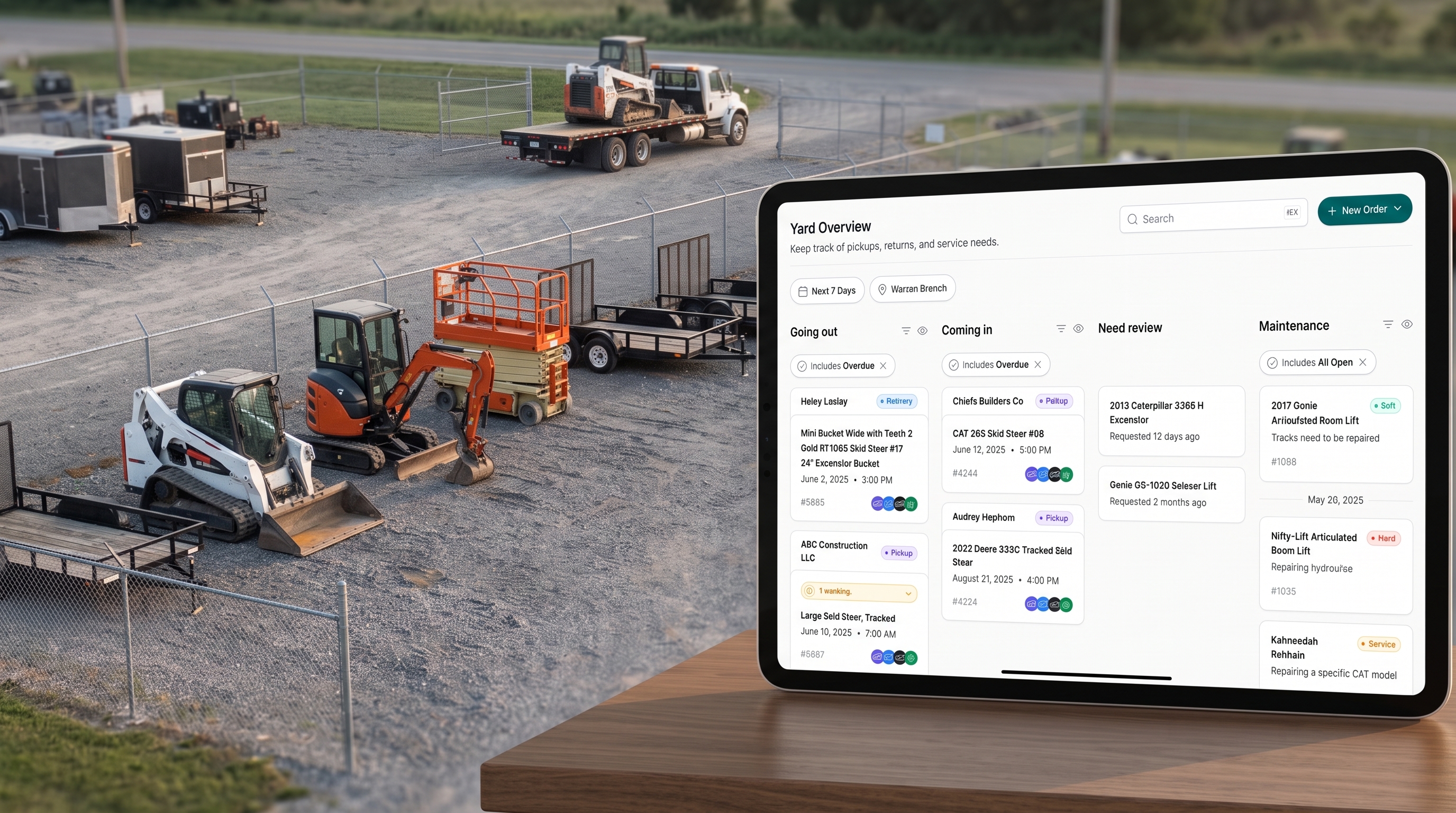
Renterra's live yard view is built around exactly this. It shows one real-time view of every unit's location and status across all of your yards, rather than a separate picture per location that someone has to manually reconcile. It connects directly to inventory management and scheduling and quoting, so a quote at Yard B can pull from Yard A's inventory without a phone call.
Building a Process, Not Just Buying Software
Software solves the visibility problem, but swapping one system for another doesn't automatically solve the entire picture. A few process decisions need to be made explicitly, or the same problems resurface in a new form, just inside a nicer interface.
Standardize how equipment moves between yards
Every inter-yard transfer and on-rent swap should follow the same steps, logged the same way, regardless of which location initiates it. Without a standard, updates default to "whoever remembers to do it," which is exactly how records drift away from what's actually in the yard, and it doesn't go away just because the underlying software changed.
Decide who owns cross-location scheduling conflicts
When two locations both want the same unit for the same week, someone needs clear authority to make the call. Deciding this in advance, rather than in the moment, keeps it from becoming a recurring source of friction between location managers.
Set utilization targets per location, not just fleet-wide
Tracking utilization per location rather than only fleet-wide matters more once you're multi-location, because a healthy fleet-wide number can hide one yard running well below capacity while another is turning away bookings it could have filled from the first yard's excess inventory.
Signs You're Ready to Scale, or Signs You're Not Ready Yet
Before opening a second location, it's worth checking a few things that are much cheaper to fix before scaling than after:
- Inventory visibility: can your team currently answer "what do we have available right now" without walking the yard, making a phone call, or exporting two reports and comparing them by hand? If not, you're already relying on hope instead of a system at one yard, and a second location doubles the ways that can go wrong.
- Demand data: do you have enough rental history to justify a second location's fleet mix, or would it be built on guesswork? Look at where your deliveries actually go. If you're regularly hauling equipment to jobsites in the same area far from your yard, that's often the clearest sign of where a second location would pay off.
- Staffing and ownership: is there a clear owner for cross-location decisions (transfers, scheduling conflicts), or will that fall through the cracks in the day-to-day?
Businesses that solve inventory visibility before opening a second yard tend to scale with far less disruption than those that try to bolt it on afterward.
Visibility, Not More Equipment, Is Usually the Real Fix
The hardest part of running a rental business usually isn't the equipment. It's knowing where it is, in real time, without a phone call or a side spreadsheet to reconcile. That's true at one yard, and it only gets harder at two. Solve it, and you trade hoping everything lines up for knowing it does, along with most of the double bookings, missing units, and scheduling friction that come with growth.
See how Renterra's live yard view gives your team a real-time picture of every unit, whether you run one yard or several. Book a demo and see it working with your own fleet.
FAQ
How do rental companies manage inventory across multiple locations?
The most reliable approach is a shared, real-time inventory system that every location can see and update, rather than separate spreadsheets, phone calls, or disconnected instances of the same software per yard that require manual reconciliation. Transfers between locations are logged at the moment they happen so every yard's view stays accurate.
What's the difference between fleet-wide and per-location utilization tracking?
Fleet-wide utilization averages performance across all locations, which can mask a specific yard underperforming. Per-location tracking shows each yard's actual utilization, making it possible to rebalance inventory between locations rather than assuming the fleet overall is healthy.
Can equipment be transferred between rental locations mid-rental?
Yes. The most common version is a swap: a unit breaks down on a job and a replacement goes out to keep the customer working. The ticket needs to reflect the replacement the moment it leaves the yard. Otherwise the swap unit can stay on the jobsite long after the original is returned and the contract is closed.
How many locations before this becomes a real problem?
The problem exists at one location. It just becomes impossible to ignore at two. With a single yard, staying accurate depends on someone walking the yard or remembering which unit is down, which works until the day it doesn't. A second location takes away even that fallback.
We already run rental software. Do we need to replace it, or can it be adapted for a second yard?
It depends on whether the system was designed for multiple locations from the start or whether multi-location support was added on afterward. Single-location rental software can sometimes be stretched across two yards by running a second instance, exporting reports, or relying on phone calls between teams, but most rental businesses find that reconciliation becomes a near full-time task on its own past two locations. The first question to ask isn't old software vs. new software; it's whether your current system treats every yard as one connected inventory or whether that connection currently lives in your team's heads.
Top Reasons Rental Companies Are Switching to Modern Rental Software
Most rental businesses don't decide to replace their software on a quiet Tuesday. It happens after a busy weekend when two customers showed up for the same skid steer, or after month-end close took three days because invoices lived in one system and payments in another.
That's why more rental companies are moving to modern rental software: cloud-based platforms that connect quoting, reservations, dispatch, maintenance, and invoicing in one place. Below are the five reasons we hear most often, what each one looks like in day-to-day operations, and how to tell whether your business is ready to make the switch.
Modern Rental Software vs. Legacy Systems: A Quick Comparison
Before getting into the reasons, it helps to be clear about what "modern" actually means. It isn't just a newer interface, it's a different way of structuring the business's data.
1. Streamlined Operations Across the Business
The biggest cost of disconnected systems isn't any single tool. It's the gaps between them. A quote gets written in one place, re-entered as a reservation in another, and re-keyed a third time as an invoice. Every hand-off is a chance for a typo, a missed charge, or a lost piece of paper.
Modern rental software ties the full rental lifecycle together:
- Quoting and reservations pull from live inventory, so the counter never promises a unit that's already out.
- Dispatch and delivery see the same bookings sales does, without a hand-written schedule.
- Maintenance tracking automatically takes units out of the available pool when they're down for service.
- Invoicing is generated from the rental itself, not rebuilt from notes.
One source of truth for every team
When sales, dispatch, service, and accounting work from the same record, questions like "is this unit available Friday?" or "did this customer pay?" get answered in seconds instead of with a phone call. Renterra's scheduling and quoting and inventory management are built to share that single record end to end
2. Mobile Access That Works Beyond the Counter
In rental, much of the work never happens at the counter. Equipment gets checked out in the yard, delivered to job sites, and repaired in the shop. If your system only runs on the office computer, each of those moments becomes a note on a clipboard that someone has to type in later.
Modern rental software runs on phones and tablets. Your team can work wherever the equipment is.
- In the yard: Check units in and out, update their status, and see what's available without walking back to the office.
- Away from the counter: Create orders, contracts, invoices, and more from the road, yard, and beyond.
- On a delivery: Drivers see order details on their phone, capture a signature at drop-off, and mark the job complete on the spot.
- In the shop: Technicians log repairs, parts, and hours as they work. A unit goes back into available inventory as soon as it's ready.
- At pickup and return: Staff complete inspections from a tablet with timestamped photos and condition notes.
- Business metrics on the go: Managers can see how the business is running from anywhere and check key metrics and reports.
Fewer clipboards, fewer surprises
When updates happen in the moment, everyone sees the same picture. The counter knows a unit is back and ready to rent, and accounting knows a delivery is done. If a customer disputes damage, the photos from pickup are already on file.
3. A Better Customer Experience
Rental customers (contractors, homeowners, event planners, you name it) increasingly expect the same convenience they get from any other online purchase as they do with equipment rentals. If booking a trailer requires a phone call during business hours and a trip to the counter to sign paperwork, some of those customers will book with the competitor who lets them do it from their phone.
Modern platforms make that experience possible with features like:
- Online booking through a digital storefront that takes reservations 24/7
- Customer portals where renters can view active rentals, documents, and invoices
- Electronic signatures that replace printed contracts at pickup
- Text links for invoices and payments so customers can pay in a tap
- Automated notifications for pickup reminders, return dates, and overdue rentals
Faster checkouts, more repeat business
Every minute cut from the counter is a minute your team can spend on the next customer, especially during busy season. A smoother, more professional experience also builds the kind of trust that turns a one-time renter into a regular account.
4. Real-Time Insights for Smarter Decisions
Legacy systems capture data, but getting anything useful out of them usually means exporting to a spreadsheet and building a report by hand. By the time the report is done, the numbers are already stale.
Modern rental management software makes that data actionable as it happens. Owners and managers can:
- Track equipment utilization to see which units earn their keep and which sit idle
- Monitor revenue trends by category, location, or customer
- Forecast maintenance needs based on hours, rentals, or service intervals
- Spot problems early, like a category that's consistently sold out or a location running below capacity
Decide based on facts, not guesswork
When usage data is live, fleet decisions get easier: buy more of what's always booked, sell or relocate what isn't, and schedule service before a breakdown costs you a rental. For a closer look at which numbers matter most, see our guide to the KPIs every equipment rental business should track
5. Easier Scalability and Growth
What works for a single yard with a few dozen units rarely works for three yards and a few hundred. As a rental business grows, it adds locations, staff, customers, and equipment, and each one multiplies the coordination required. Legacy systems, especially on-premise ones tied to a single office computer, often become the bottleneck.
Cloud-based rental software is built to scale with the business:
- Multiple locations share one real-time inventory, so any yard can see and book any unit.
- Larger fleets are tracked without extra spreadsheets or manual reconciliation.
- New team members can be onboarded with role-based access instead of shared logins.
- Remote access means managers can check the business from the job site, the road, or home.
Growth without new bottlenecks
Renterra's live yard view gives every location the same picture of every unit's status, so adding a second or third yard doesn't mean adding a second or third set of problems.
6. A Competitive Advantage in a Crowded Market
The rental industry keeps growing, and so does competition. In that environment, equipment alone rarely sets a business apart. How easy you are to work with does.
Companies running modern rental software are better positioned to:
- Respond faster to quote requests and availability questions
- Offer self-service options that competitors on paper can't match
- Reduce errors in billing and scheduling that erode customer trust
- Operate leaner, keeping margins healthy when pricing gets competitive
Being easy to work with is a differentiator
When two rental companies offer the same equipment at similar prices, customers choose the one that answers quickly, gets the order right, and doesn't make them fill out paperwork twice.
Signs It's Time to Switch From Your Current System
Not sure whether your business has outgrown its current setup? A few common warning signs:
- Double bookings or "phantom" inventory happen more than once a quarter.
- The same information is entered in two or more places (quote, contract, invoice).
- Month-end reporting takes days, not minutes.
- Only one or two people know how the system works, and everything stops when they're out.
- Customers ask for online booking or digital payments you can't offer.
- You're planning to add a location or grow the fleet and can't picture your current tools handling it.
If a few of these sound familiar, it's likely time to evaluate modern equipment rental software.
Setting Your Rental Business Up for the Future
Rental businesses that stay on spreadsheets and legacy systems aren't standing still. They're falling behind competitors who can quote faster, book online, and see their whole fleet at a glance. Moving to modern rental software isn't just a technology upgrade. It's a foundation for faster growth, stronger customer relationships, and a more profitable business.
Ready to see how Renterra can help you modernize your rental business? Schedule a demo today and take the first step toward a better way to rent.
FAQs
What is modern rental software?
Modern rental software is a cloud-based platform that manages the full rental lifecycle (quoting, reservations, contracts, dispatch, maintenance, invoicing, reporting, and more) in one connected system that can be accessed from any device.
What's the difference between cloud-based and on-premise rental software?
On-premise software is installed on local computers or servers, so access and updates depend on that hardware. Cloud-based rental software runs online, updates automatically, and lets staff at any location, or in the field, work from the same real-time data.
Is switching rental software difficult?
It takes planning, but it's more manageable than many businesses expect. Most providers help import existing customer, inventory, and rental data, and a phased rollout lets your team learn the system without disrupting daily operations.
Is modern rental software only for large rental companies?
No. Small and mid-sized rental businesses often see the biggest gains, because they have fewer people to absorb the manual work that disconnected systems create. Cloud-based pricing also makes modern software accessible without a large upfront investment.
What features should I look for in equipment rental software?
Look for real-time inventory across locations, online booking, electronic signatures, integrated payments and invoicing, maintenance tracking, utilization reporting, and accounting integration. Mobile access for the counter and the field is increasingly essential too.

The Common Accounting Challenges Facing Equipment Rental Companies
Equipment rental is one of the more financially complicated business models out there. Unlike a typical retailer that sells a product once and closes the books on the transaction, a rental company is managing the same asset across dozens or hundreds of transactions over its lifetime, each with its own billing period, damage waivers, taxes, and eventual depreciation curve.
That complexity doesn't stay on the yard. It flows straight into the accounting department.
Here are some of the accounting challenges that come up again and again for equipment rental businesses, why so many operators are rethinking how their financial systems connect to the rest of their operation, and what can actually be done about it.
1. Revenue Recognition Isn't Straightforward
A single rental contract can span days, weeks, or months, and customers frequently extend, shorten, or modify their rental mid-stream. That means revenue often needs to be billed and recognized on a month-by-month basis rather than all at once.
Add in early returns, extensions, exchanges, and rate changes mid-contract, and calculating exactly how much revenue should hit the books in a given period becomes a real exercise, especially when it's being done manually in a spreadsheet instead of by a system that understands rental terms natively.
2. Fixed Asset and Depreciation Tracking at Scale
Rental fleets are capital-intensive. Every unit is a fixed asset with its own purchase price, useful life, depreciation method, and eventual resale or disposal value. Multiply that by a fleet of hundreds or thousands of units, and depreciation schedules can become one of the heaviest lifts in the accounting function.
Recent tax law changes, including the return of 100% bonus depreciation and a higher Section 179 expensing limit, have made this even more consequential. Getting depreciation and asset lifecycle accounting right isn't just a bookkeeping exercise anymore; it has a direct, material impact on tax liability and cash flow.
3. Disconnected Systems Create Duplicate Work
This is probably the most common pain point of all. Many rental companies still run their operations software (contracts, dispatch, inventory) or even pen & paper, separately from their accounting software (QuickBooks, Sage, or similar). That means every invoice, payment, credit memo, and adjustment has to be manually re-entered, or exported and imported, between systems.
Manual double entry doesn't just cost time. It's a constant source of reconciliation errors, mismatched totals, and month-end surprises when the rental system and the general ledger don't agree.
4. Billing Accuracy for Ancillary Charges
Rental invoices are rarely just "X days at Y rate." Fuel charges, delivery and pickup fees, damage waivers, cleaning fees, late fees, and consumables all need to be tracked and billed accurately, and each one is easy to miss if it depends on a yard employee remembering to write it down.
Fuel alone is a good example of how this adds up. A rental company doing 1,500 rentals a year with an average missed fuel charge of $35, missed on just a quarter of rentals, is leaving over $13,000 on the table annually. Multiply that pattern across every ancillary charge type, and the revenue leakage becomes significant, and it all shows up as inaccurate, hard-to-audit revenue in the accounting system.
5. Sales and Rental Tax Complexity
Rental tax rules vary widely by state, county, and even municipality, and they often differ from standard retail sales tax rules (e.g. based on the site of delivery vs. your store's location).
Knowing exactly how much tax is owed, when it's owed, and where it's owed is one of the biggest hidden pain points in rental accounting. Without a system underneath the business that's tracking every jurisdiction, rate, and rule automatically, it's extremely difficult to know whether you're over-charging customers, under-collecting on behalf of the state, or simply guessing. For companies operating across multiple locations or states, keeping tax calculation, collection, and remittance accurate is a persistent compliance burden, and getting it wrong can mean penalties that show up months or years after the fact.
6. Reconciling Payments Across Multiple Methods
Rental businesses rarely get paid one way. On any given day, a branch might take cash at the counter, checks that arrive by mail, credit card payments that show up net of processing fees, and ACH or online payments that settle on their own schedule. Reconciling all of that against what the operations system says was actually charged is a genuine headache.
Drawer management alone is a common source of discrepancies (over/short cash counts at shift changes), and checks can take days to clear and show up out of sequence on a bank statement. Credit card batches settle with fees already deducted, so the amount that hits the bank account rarely matches the amount that was charged on the invoice, which means someone has to manually back into the gross amount, the fee, and the net deposit for every batch. Multiply this across branches and payment types, and reconciling "what we billed" against "what actually landed in the bank" becomes a recurring, manual, error-prone project rather than a simple check of the books.
7. Accounts Receivable and Cash Flow Management
Rental businesses often extend credit to commercial customers, collect security deposits, and manage recurring billing for long-term rentals. That creates a lot of moving parts on the receivables side: tracking open invoices, aging balances, applying deposits and credits correctly, and following up on collections without damaging the customer relationship.
Slow collections directly compress cash flow, which matters a lot in a capital-intensive business where cash is needed to maintain and reinvest in the fleet.
8. Multi-Location and Multi-Entity Consolidation
As rental companies grow, adding branches, acquiring smaller operators, or expanding into new regions, consolidating financials across locations or legal entities becomes its own challenge. Each location may have slightly different processes, chart of accounts usage, or even software, making it harder to get a single, accurate, real-time view of company-wide performance.
9. Inventory and Maintenance Cost Allocation
Deciding which maintenance and repair costs should be capitalized (added to the asset's book value) versus expensed immediately is a recurring judgment call in rental accounting. Get it wrong consistently, and it can distort both your balance sheet and your understanding of true equipment profitability, making it harder to know which units, categories, or locations are actually driving margin.
10. Slow, Manual Month-End Close
When contracts, payments, and adjustments live in one system and the general ledger lives in another, closing the books becomes a reconciliation project rather than a routine process. Finance teams end up spending days chasing down discrepancies between rental activity and accounting records instead of analyzing the numbers and helping the business make decisions.
11. The Cost of Doing It Properly in the First Place
There's one more pain point underneath all of these: for smaller, growing rental businesses, hiring a full-time, experienced accountant or bookkeeper simply isn't in the budget yet. Tight controls, clean revenue recognition, correct tax treatment, and disciplined reconciliation all take real expertise to maintain, and that expertise costs money that an independent or midsize operator may not have to spare.
The result is that a lot of proper accounting practice quietly goes by the wayside. Not because owners don't care about getting it right, but because someone is running the yard, managing customers, and trying to keep the books in order all at once, usually without the training or the time to do all three well. Small inconsistencies pile up, and by the time they surface (often at tax time or during a bank review) they've become a much bigger cleanup project than they needed to be.
So What Can Rental Companies Do About It?
Given all of the above, the real fix usually isn't hiring a bigger accounting team. It's removing as much manual, error-prone work from the process as possible by choosing a rental operating system that's genuinely built to work with your accounting system, rather than alongside it.
A rental management platform with a full general ledger that integrates automatically with an accounting system like QuickBooks Online can put much of this on autopilot. When contracts, billing, fuel and damage charges, and payments all flow into the same source of truth as the GL, revenue recognition, depreciation tracking, and payment reconciliation stop being manual reconciliation projects and start happening as a byproduct of normal operations.
Sales tax is worth calling out specifically. A system that calculates rental sales tax for you, correctly, by jurisdiction, and keeps it updated as rules change, is critical to knowing the right amounts are owed at the right times, without a finance team having to track every local rule by hand.
And finally, it matters who you partner with, not just what software you buy. You want a software partner that makes sure your accounting workflows are set up correctly from day one, not just a tool you have to configure and maintain yourself. This is one of the things that makes Renterra unique: Renterra provides an in-house CPA to assist with onboarding and with any ongoing accounting questions that come up, so growing rental businesses get the benefit of real accounting expertise without having to hire it themselves.
That's the gap platforms like Renterra's Integrated Accounting are built to close: connecting contracts, billing, ancillary charges, tax calculations, and payments directly to the general ledger, so revenue, receivables, and asset records stay accurate without manual re-entry. When rental operations and accounting share the same source of truth, month-end stops being a scramble and starts being a formality.
Why a Modern Website Is Now Essential for Equipment Rental Companies
The equipment rental industry has always been built on relationships.
Great service, knowledgeable employees, responsive communication, and strong local reputations remain some of the most important factors that drive customer loyalty. Contractors still value working with people they know and trust. They still call rental counters for advice. They still rely on experienced rental professionals to help solve problems and keep projects moving.
What has changed is how those relationships often begin.
Today, the vast majority of rental customers start their buying journey online. Before contacting your branch for the first time, requesting a quote, or stepping foot inside your store, they're researching equipment, comparing providers, reading reviews, and evaluating their options.
For rental companies, this means your website is no longer simply a marketing asset. It has become one of the most important touchpoints in the customer journey and, increasingly, one of the most important drivers of revenue growth.
A modern rental website is no longer just a digital brochure. It has become a sales channel, a customer service platform, a marketing engine, and an extension of your rental counter itself.
The Modern Rental Customer Starts Online
Whether someone needs a skid steer, boom lift, generator, mini excavator, or forklift, their process typically begins long before they ever contact a rental company.
Most customers start with a Google or Google Maps search. They compare local providers, browse available equipment, review specifications, evaluate pricing, and read customer reviews. By the time many customers reach out to a rental company, they've already narrowed their list of potential providers and formed opinions about which businesses appear most capable of meeting their needs.
Industry studies consistently suggest that 70%+ of rental transactions begin with some form of online research. While the final transaction may still involve a phone call, a branch visit, or a conversation with a salesperson, the buying decision is increasingly influenced by the online experience that comes beforehand.
This shift has fundamentally changed the role of a rental company's website.
In many cases, your website creates a customer's first impression of your business long before they ever speak with someone on your team. An outdated website, limited equipment information, poor mobile experience, or lack of self-service capabilities can create friction before a conversation ever occurs.
Conversely, a professional and modern online experience builds trust and credibility before the first phone call.
Customer Expectations Continue to Rise
Today's renters expect much more than a simple equipment catalog.
Customers increasingly want immediate answers to questions like:
- Do you have the equipment I need?
- Is it available?
- What does it cost?
- What are the specifications?
- Can I request a quote online?
- Can I reserve equipment digitally?
- Can I manage my account without calling?
These expectations aren't unique to equipment rental. They are shaped by virtually every other online experience customers have throughout their day.
People can book flights, order products, schedule services, manage bank accounts, and pay bills online. Naturally, they increasingly expect the same level of convenience when renting equipment.
When information is difficult to find or processes require unnecessary phone calls and back-and-forth communication, many customers simply move on to another provider.
And for companies that provide a seamless experience, they create customers for life. The companies that make it easiest to do business with them often win.
Visibility Matters More Than Ever
One of the biggest challenges facing independent rental companies today is simply making inventory visible online.
Many rental businesses still have websites that provide limited information about the equipment they offer. Customers may see a basic product listing (which is often outdated!) but have no visibility into specifications, pricing, availability, or related rental information. This creates friction in the buying process.
The more information customers can access on their own, the easier it becomes for them to move forward with confidence.
Visibility is also closely tied to search engine optimization (SEO). A great website is only valuable if customers can actually find it. Search engines remain the primary way most customers discover rental providers, making SEO one of the most important aspects of a modern website strategy. Rich equipment descriptions, detailed specifications, optimized page content, location-specific pages, and customizable metadata all play an important role in helping rental companies rank higher in search results.
In many cases, the rental company that appears first in search results earns the opportunity before competitors even get a chance to participate.
As competition for online visibility continues to increase, strong SEO capabilities are becoming just as important as having inventory available online.
Customer Portals Are Becoming a Competitive Necessity
The expectations don't stop after the rental begins. Increasingly, customers want self-service access to their rental accounts.
Think about how people interact with banks, airlines, utility providers, and virtually every other service they use. Customers have become accustomed to logging in and accessing information whenever they want rather than waiting for business hours or calling customer support. Equipment rental is heading in the same direction, with every large national company now supporting online Customer Portals.
Many renters now expect the ability to:
- View active rentals
- Review invoice history
- Pay open invoices online
- Submit call-off requests
- Request rental extensions
- Access account information
- Review past rental activity
For rental companies, customer portals create benefits that extend far beyond convenience.
Reducing inbound phone calls, speeding up collections, minimizing administrative work, and improving customer satisfaction can have a meaningful impact on operational efficiency. What was once viewed as a premium feature is quickly becoming an expected part of the rental experience.
Artificial Intelligence Is Changing the Online Rental Experience
Another major shift occurring across the industry is the growing role of artificial intelligence. Customers have become increasingly comfortable interacting with AI-powered tools when shopping online. Rather than manually searching through pages of inventory or navigating complex websites, they increasingly expect technology to help guide them toward the right solution.
The rental industry is beginning to embrace this trend as well. United Rentals recently introduced an AI-powered website assistant designed to help customers find equipment and navigate their online experience more effectively. This is likely only the beginning.
Imagine a customer visiting your website and asking:
"I need a lift that can reach 40 feet."
Or:
"What's the best machine for moving pallets around a warehouse?"
Instead of forcing the customer to browse dozens of equipment listings, an AI assistant can identify relevant equipment, explain specifications, answer common rental questions, and guide the customer toward requesting a quote. The goal isn't to replace your rental experts. The goal is to provide customers with faster access to information while helping them move more efficiently from browsing to renting.
In many ways, AI is becoming a digital extension of the rental counter.
Online Revenue Is Becoming a Meaningful Growth Driver
For many rental companies, websites have traditionally been viewed as marketing tools. Increasingly, they are becoming direct revenue-generating channels.
Across Renterra's customer base, many rental businesses now generate more than 25% of their rental activity directly through their online storefronts. Many have generated well over $100,000 in online rental revenue through digital channels.
Customers are discovering equipment, requesting quotes, browsing inventory, and initiating transactions online at all hours of the day. This doesn't replace relationships or sales teams. Instead, it creates a more efficient buying experience that helps rental companies capture opportunities they may have otherwise missed.
For businesses looking to grow revenue without proportionally increasing administrative workload, online requests represent a significant opportunity.
What Defines a Modern Rental Website?
A modern website is much more than an online equipment catalog.
The best rental websites combine discoverability, functionality, branding, and customer convenience into a single experience.
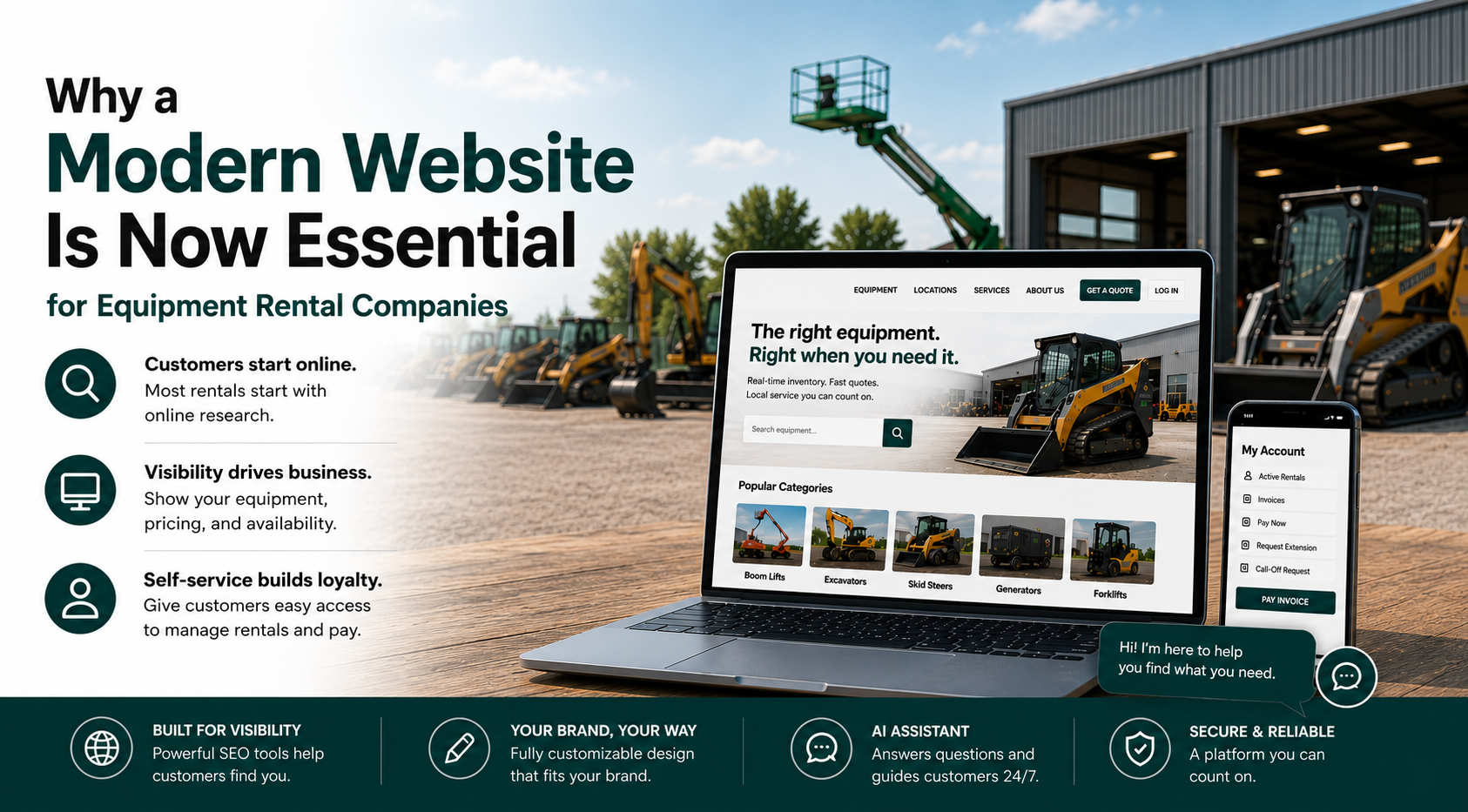
Key characteristics of a modern rental website include:
- Real-time inventory visibility
- Mobile-friendly design
- Rich equipment descriptions and specifications
- Strong SEO capabilities
- Self-service quoting and booking
- Customer portal functionality
- AI-powered customer assistance
- Brand customization and design flexibility
Most importantly, the website should feel like a natural extension of your business rather than a generic template.
Customers should immediately recognize your brand, understand your value proposition, and feel confident doing business with you.
Introducing Renterra's Next Generation Storefront
Recognizing how rapidly customer expectations are evolving, Renterra has just launched the second generation of its Integrated Storefront platform.
This represents a significant evolution from the original storefronts introduced several years ago and reflects the growing importance of digital experiences within the rental industry.
The goal was simple: help independent rental companies launch modern, enterprise-grade online experiences without requiring developers, designers, or lengthy implementation projects.
Live Site in Minutes
Renterra's AI can automatically generate an entire storefront using inventory that already exists within your rental software.
Equipment descriptions, specifications, images, and branded pages are generated automatically, allowing rental companies to launch professional websites in a fraction of the time traditionally required.
Real-Time Inventory
Storefronts connect directly to your Renterra account to display live inventory, pricing, and availability.
Customers can browse with confidence knowing the information they are seeing reflects your actual fleet.
Self-Service Quoting & Booking
Customers can request quotes and initiate bookings on their own schedule, creating a more convenient buying experience while reducing friction in the sales process.
Built-In Customer Portal
Existing renters can securely access their account to pay invoices, view active rentals, submit call-off requests, request extensions, and review account history.
This creates a better customer experience while reducing administrative workload for your team.
AI Storefront Assistant
An embedded AI storefront assistant acts as a digital rental expert available 24/7.
Customers can ask questions about equipment, receive guidance on which machine may be best suited for a project, learn about specifications, understand rental policies, and quickly locate inventory that matches their needs.
The result is a faster path from browsing to booking while reducing repetitive questions directed to your staff.
Powerful SEO Controls
Renterra's next-generation storefronts are designed with search visibility in mind. Rental companies can customize page content, metadata, imagery, and other SEO-focused elements to help improve discoverability and drive more organic traffic.
Full Design Customization
Every rental company has a unique identity. Storefronts can be fully -customized with unique colors, themes, imagery, layouts, and page styling so the website feels like a natural extension of your brand rather than a generic rental website template.
This allows independent rental companies to maintain the personality and local identity that often differentiates them from larger national competitors.
The Bottom Line
The fundamentals of the rental industry haven't changed. Relationships still matter. Service still matters. Trust still matters.
What has changed is how customers discover, evaluate, and engage with rental companies. A modern website is no longer a luxury reserved for national rental chains. It has become a critical component of competing in today's market. Customers expect visibility into inventory. They expect self-service capabilities. They expect modern design. They expect strong online search experiences. Increasingly, they expect intelligent tools that help them find what they need faster.
The good news is that independent rental companies no longer need massive budgets or dedicated development teams to deliver these experiences. With the right technology, businesses of any size can provide the modern online experience today's renters expect while continuing to deliver the exceptional service and relationships that have always defined the rental industry.
Rising Fuel Costs Are Eating Into Rental Margins. Are You Recovering Every Dollar?
Why Fuel Recovery Matters More Than Ever
Fuel has always been a significant operating cost for equipment rental companies. But when global events create sudden shocks in energy markets, fuel management becomes even more critical.
Recent geopolitical tensions, including the ongoing conflict in the Middle East, have added uncertainty to global oil markets and increased the risk of sharp price swings in diesel, gasoline, and propane. Even if prices do not spike overnight, periods of instability can materially increase operating costs and compress margins.
For rental businesses, that means every missed fuel charge becomes more expensive.
A skid steer returned half empty might represent a $25 charge. A large excavator could consume more than $200 of diesel on a single rental. If those charges are missed, estimated incorrectly, or underbilled, the costs are absorbed directly by your business.
And because each missed charge may seem small in isolation, the financial impact often goes unnoticed.
Consider a rental company with:
- 1,500 rentals per year
- Average missed fuel charge of $35
- Fuel charges missed on just 25% of rentals
That results in:
1,500 × 25% × $35 = $13,125 in annual lost revenue
For larger rental businesses, the impact can easily reach tens of thousands of dollars each year. At Renterra, we recently launched a major upgrade to our fuel management capabilities to help rental companies accurately capture fuel usage, automate billing, and ensure every gallon consumed is billed correctly.
Fuel costs affect nearly every segment of the rental industry:
- Diesel for excavators, dozers, and skid steers
- Gasoline for smaller tools and equipment
- Propane for heaters and forklifts
- Transportation costs associated with deliveries and pickups
When fuel prices are stable, small inefficiencies may go unnoticed. But when markets become volatile, those inefficiencies have a much larger impact on profitability. In uncertain times, rental companies need confidence that:
- Fuel usage is captured accurately
- Charges reflect actual consumption
- Billing rates can be adjusted quickly
- No recoverable revenue slips through the cracks
Common Fuel Management Mistakes
Many rental companies still rely on manual or inconsistent processes. Common issues include:
- Fuel levels not recorded at checkout or delivery
- Fuel levels not recorded upon return
- Employees estimating usage
- Missing or inaccurate tank capacity data
- Charges added manually and forgotten
- Lack of accountability across the yard and front counter
These small process breakdowns add up quickly.
Why Customers Expect Accurate Fuel Billing
Most customers have no issue paying for the fuel they consume. Problems arise when charges appear arbitrary or unsupported.
Clear documentation makes all the difference.
When an invoice shows:
- Starting fuel level
- Ending fuel level
- Quantity consumed
- Price per gallon
customers are far less likely to dispute the charge.
Accurate fuel tracking protects margins while improving trust and transparency.
Fuel Tracking Methods Used by Rental Companies
Track by Percentage of Tank
In this method, employees record the fuel level at check-out and again at check-in as a percentage of the tank, such as 100%, 75%, or 50%.
The system then uses the unit's stored fuel tank capacity to calculate the quantity consumed.
For example:
- Fuel tank capacity: 80 gallons
- Check-out level: 100%
- Check-in level: 60%
- Fuel consumed: 32 gallons
Pros
- Fast and intuitive for yard staff
- Matches what employees see on the machine's fuel gauge
- Automatically converts percentages into gallons or liters
- Works well across nearly all equipment types
Considerations
- Requires accurate tank capacity data
The good news is that modern software can help automate this. Renterra uses AI to identify likely fuel tank capacities based on equipment make and model, making setup much faster and more accurate.
Track by Gallons or Liters
In this method, fuel is tracked directly in gallons or liters.
This can be done by:
- Entering the number of gallons required to refill the machine
- Calculating the difference between the quantity recorded at check-out and check-in
Pros
- Highly precise when exact refill quantities are known
- Ideal when using fuel receipts or pump readings
- Can still be calculated automatically by the system
Considerations
- Not always practical if staff do not have a reliable way to measure exact quantities
Both methods are effective, and the best rental software supports whichever approach fits your operation.
Building a Well-Oiled Fuel Recovery Process
A strong fuel management process delivers benefits well beyond additional revenue.
- Improved Profitability: Every gallon consumed is billed accurately.
- Faster Check-In: Return inspections become more standardized and efficient.
- Fewer Billing Disputes: Customers can clearly see how charges were calculated.
- Better Operational Data: Fuel usage trends can reveal inefficiencies and maintenance issues.
- Stronger Accountability: Yard and service teams follow a consistent process every time.
Best Practices for Fuel Management
- Store Tank Capacity for Every Unit: Each asset should include fuel capacity information.
- Capture Fuel at Check-Out and Check-In: Consistent documentation is the foundation of accurate billing.
- Automate the Calculations: Eliminate manual math and reduce mistakes.
- Add Charges Automatically: Fuel fees should flow directly into the rental contract and invoice.
- Review Exceptions: Audit rentals where fuel was not captured or billed.
How Renterra Automates Fuel Billing
Renterra's new fuel enhancements were built specifically for equipment rental businesses.
Flexible Tracking Options
Track fuel by:
- Percentage of tank
- Gallons or liters
- Propane quantity
- Unit-Level Fuel Capacity: Store the tank size for every piece of equipment and let the system calculate actual usage automatically.
- AI-Powered Capacity Lookup: Use AI to identify likely tank capacities based on manufacturer and model information.
- Check-Out and Check-In Fuel Capture: Yard staff can record fuel levels directly within dispatch and return workflows.
- Automatic Billing: When equipment is returned, fuel charges are automatically added to the rental totals.
- Complete Audit Trail: Every starting level, ending level, quantity, and charge is stored for future reference.
See Fuel Charges Added Automatically
In the example above, fuel information captured during the rental process flows directly into the billing summary and final invoice. No manual calculations. No forgotten line items. No lost revenue.
Example: Fuel Billing in Action
A Caterpillar 320 Excavator has a 120-gallon fuel tank.
- The machine leaves the yard at 100% fuel.
- It returns at 65%.
- Renterra calculates that 42 gallons were consumed.
- Your configured diesel rate is applied automatically.
- The fuel charge is added to the contract and invoice.
The process takes seconds and ensures every recoverable dollar is captured.
Ready to Tighten Up Fuel Recovery?
Renterra helps equipment rental companies automate fuel tracking, eliminate missed charges, and improve margins. If you'd like to see our new fuel features in action, request a demo and discover how much revenue your business may be losing today.

Renterra Raises $9M Series A to Power the Future of Equipment Rental
We’re excited to share a major milestone in Renterra’s journey. We’ve closed a $9 million Series A funding round led by Avenue Growth Partners, with continued support from existing investors. This marks an important step forward as Renterra continues to build the next-generation operating system for modern equipment rental businesses.
Since launching, Renterra has grown rapidly to serve hundreds of rental companies across the U.S. and Canada, helping them manage everything from inventory and contracts to online bookings, payments, and customer communications.
This new capital will allow Renterra to significantly accelerate product development, expand its engineering and customer success teams, and continue investing in AI in a way that is practical and directly useful for rental businesses. Renterra is focused on applying AI to help rental companies work faster, make better decisions, operate more profitably, and deliver a better experience to their customers.
Avenue Growth Partners brings deep experience in scaling vertical SaaS businesses and partnering closely with founders to build category-defining platforms. Their team has helped guide numerous fast-growing software companies through their next stages of growth, making them a strong strategic partner as Renterra expands its footprint and solidifies its position as a leader in bringing AI to the rental industry.
“We built Renterra to give rental businesses the same modern tools that power the best technology companies in the world,” said Andy Feis, Co-Founder and CEO of Renterra. “Rental businesses are the backbone of construction, infrastructure, and local economies, yet they have historically been underserved by technology. We are building the platform that will define how this industry operates for the next decade, with a strong focus on applying AI in a real-world, practical way for rental companies. We are thrilled to partner with Avenue Growth Partners and our existing investors to keep pushing that vision forward.”
The funding will also support Renterra’s growing customer base, with new investments in onboarding, support, and implementation to ensure rental companies get value from day one and continue to scale confidently on the platform.
Renterra is grateful to its customers, partners, and team members who have helped make this milestone possible. The company looks forward to sharing more product launches, partnerships, and growth in the months ahead as it continues to build the future of equipment rental.
Renterra is hiring across the board. If you are excited about building the future of equipment rental software and helping bring practical AI to a traditionally underserved industry, you can explore open roles and apply at: https://getrenterra.com/careers
.avif)
What Recent Tax Law Changes Mean for Equipment Rental Companies
In July 2025, Congress passed sweeping new tax legislation—formally called the One Big Beautiful Bill Act—that introduces several changes with major benefits for the construction equipment rental industry.
Here’s a breakdown of the most relevant updates and how they can impact your business operations and bottom line.
1. 100% Bonus Depreciation Is Back
What changed: Businesses can now deduct the entire cost of most equipment in the year it's purchased and placed into service. This applies to both new and used assets.
Why it matters:
Rental companies can now fully write off purchases like loaders, lifts, and trailers immediately—rather than depreciating them over several years. This significantly lowers taxable income and boosts short-term cash flow, freeing up more capital to reinvest in your fleet.
2. Higher Section 179 Expensing Limit
What changed: The annual limit for Section 179 deductions increased to $2.5 million, with phase-out beginning at $4 million.
Why it matters:
This is especially helpful for small to mid-sized rental businesses. If you purchase several pieces of equipment in a single year, you can now deduct more of those costs upfront—helping you reduce tax liability and keep more cash in the business.
3. Full Deduction for New Facilities or Improvements
What changed: Businesses can now fully expense certain nonresidential property improvements or construction projects—as long as construction begins after January 19, 2025, and the property is placed in service by 2031.
Why it matters:
If you’re expanding a yard, upgrading a maintenance shop, or building a new location, you can deduct the full cost in the year it's completed. This lowers the cost of growth and makes it easier to invest in infrastructure.
4. Improved Interest Deduction Rules
What changed: The limit on how much interest businesses can deduct was loosened—now calculated based on EBITDA instead of EBIT.
Why it matters:
Rental businesses that borrow money to finance equipment or facility purchases can now deduct a larger portion of their interest costs. This makes borrowing more tax-efficient and may make debt financing more attractive.
5. Immediate Write-Off for R&D Expenses
What changed: Companies can now immediately deduct U.S.-based research and development costs in the same year they’re incurred.
Why it matters:
If your business invests in new software, custom equipment modifications, or technology integrations, you can now fully expense those efforts right away. This encourages innovation while providing real tax savings.
6. Increased Deduction for Pass-Through Entities
What changed: The Qualified Business Income (QBI) deduction for pass-through businesses was made permanent and raised to 23%.
Why it matters:
If your company is structured as an LLC, S-Corp, or partnership, you may now be able to deduct 23% of your qualified business income—lowering your effective tax rate and improving take-home profit.
7. Estate Tax Relief for Family-Owned Businesses
What changed: The federal estate tax exemption rose to $15 million per person and is indexed for inflation.
Why it matters:
This is a major benefit for family-run rental companies. It makes it easier to pass the business down to the next generation without triggering costly estate taxes that could force asset sales or restructuring.
Takeaways for Equipment Rental Operators
These recent tax law changes offer some of the most business-friendly conditions in years—especially for capital-intensive industries like equipment rental. Whether you're planning to purchase new gear, expand your footprint, or invest in technology, the new rules create opportunities to lower your tax bill and strengthen your financial position.
Now is a great time to meet with your tax advisor to make sure your business strategy is aligned with these updates.
.avif)
What is a Customer Portal — and Why Your Rental Business Needs One
Today’s customers expect convenience. Whether they’re ordering equipment for a major construction site or a backyard project, they want fast, easy access to their rental information—without having to pick up the phone. That’s where a Customer Portal comes in.
If your rental business doesn’t offer an online portal yet, you could be missing a major opportunity to serve customers better, streamline operations, and grow your business.
Here’s what you need to know:
What Is a Customer Portal?
A customer portal is a secure online platform where your customers can log in and manage their rentals. Through a customer portal, customers usually can:
- View active and past rental orders
- Review, download, and pay invoices
- Request call-offs or extensions
- Update billing or contact information
Think of it as a 24/7 self-service desk for your customers—giving them full visibility into their relationship with your business, whenever and wherever they need it.
Why Your Rental Business May Need One
1. Meet Customer Expectations
Modern buyers, especially forward-thinking contractors and project managers, expect the same digital convenience they get from other industries. If you can’t offer easy online access, they may look elsewhere for their next rental.
With a portal: You position your company as modern, responsive, and easy to work with.
2. Save Time and Reduce Admin Work
Every time a customer calls to ask for an invoice copy, check a rental return date, or update a payment method, it eats into your team’s time. A portal handles these routine tasks automatically, freeing up your staff to focus on higher-value work like upselling, relationship building, and operational efficiency.
3. Speed Up Cash Flow
Late payments are a major headache for rental businesses. A customer portal makes it simple for customers to view outstanding balances and pay invoices online, leading to faster collections and healthier cash flow.
4. Improve Accuracy and Customer Satisfaction
When customers can check their rental history, order details, and invoices themselves, there’s less room for miscommunication or billing disputes. The transparency a portal provides builds trust—and a smoother customer experience can translate into repeat business and referrals.
5. Differentiate Yourself from the Competition
Many small and mid-sized rental businesses still operate the "old-fashioned" way. Offering a customer portal can help you stand out, showing that you’re not just renting equipment—you’re providing a full-service, tech-enabled experience that makes your customers' lives easier.
Final Thoughts
A customer portal isn’t just a nice-to-have anymore—it’s becoming a must-have for rental businesses that want to stay competitive and grow. Whether you’re a small operation or a multi-location rental company, giving your customers more control and visibility will pay off in better relationships, smoother operations, and a stronger bottom line.
Ready to see how Renterra’s Customer Portal can transform your business?
Schedule a demo today and take the next step toward a more modern, efficient rental experience.
Join hundreds of rental businesses already thriving with Renterra's all-in-one software solution.



Let’s make rentals easier
See how Renterra helps you work faster, get paid quicker, and keep your team on the same page.